
Public transport projects should be included in the "Plan of Ukraine"

Kyiv, 27.10.2023
As reported by the media and government websites, Ukrainian Government in coordination with the European Commission, is developing the so-called "Ukraine Plan", which is intended to become the strategic basis for the restoration and economic development of the country for the next 4 years. The European Union intends to provide financial assistance to Ukraine in the amount of 50 billion euros for this Plan. One of the sections of the Plan should be dedicated to transport and logistics.
The NGO Vision Zero and the Association of Energy Efficient Cities of Ukraine received and analysed a presentation on the transport part of the "Ukraine Plan" prepared by the Kyiv School of Economics (KSE) on behalf of the Ministry of Economy of Ukraine with the participation of private sector stakeholders. The focus of the analysis was on the public transport sector, which is of the greatest interest to cities and their residents. This sector is present in the presentation, but its representation and the proposed scope of projects (one project) do not correspond to the scale and depth of the challenges faced by transport companies and local authorities.
Public transport is mentioned in the Problem Analysis section, where the problem is identified as "Lack of a public transport development programme". In the proposals section of the presentation, two goals for public transport are set out:
Implementation of a strategic renewal programme;
Electrification of public transport.
Later, the same section mentions that the inclusion of public transport projects in the Ukraine Plan will help improve the investment climate and also meet global trends in transport and logistics.
As for the suggested projects, the presentation contains only one in the public transport sector, at the conceptual stage, with an expected investment of $17 million (the name and content of the project are not given in the presentation).
Among the transport sectors, public transport confidently ranks last, accounting for 1.15% of the possible amount of projects for 4 years ($1.477 billion), and in terms of the entire Ukraine Plan, which is designed for €50 billion, the share of proposals in the public transport sector is only 0.032%.
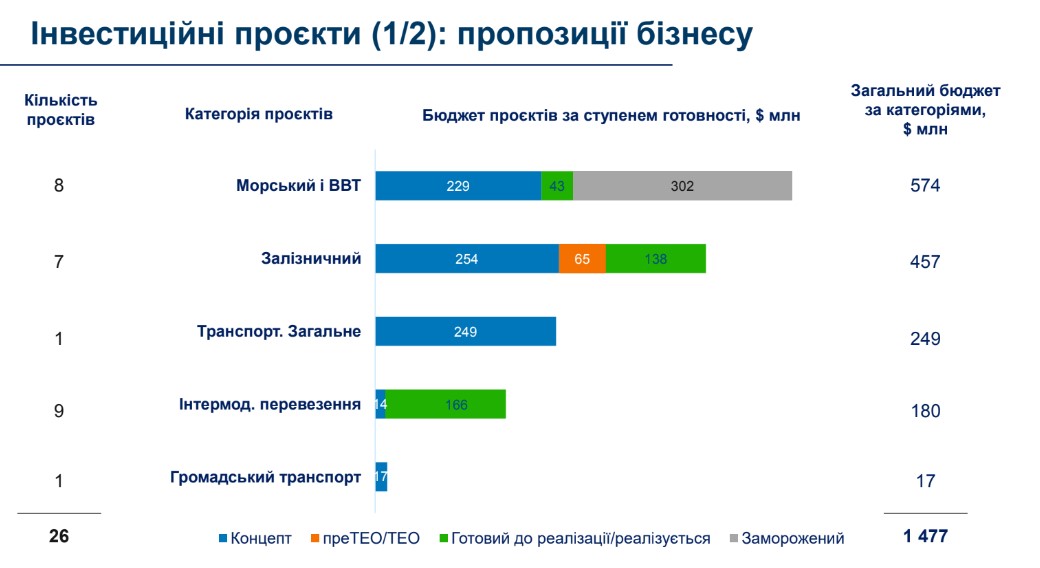
Slide from the presentation for the "Plan of Ukraine"
The Association Energy Efficient Cities of Ukraine explains the minimal level of representation of public transport in the process of preparing the "Ukraine Plan" with the fact that the "businesses" involved in public transport are municipal enterprises and usually small private companies or private entrepreneurs, and these entities were not included in the working groups and did not receive requests from either the Ministry of Economy or the KSE.
"Cities and their transport companies were not involved or asked. The investment needs of cities in the public transport sector are very, very significant. Especially in terms of infrastructure that has long been in need of modernisation: tram tracks, traction substations, repair and service workshops, car washes, power cable lines. Another important task that should be included in the Ukraine Plan is the massive renewal of the outdated fleet of trams and trolleybuses to make them energy efficient and accessible to people with limited mobility. These goals have become even more urgent during the war and will remain so after the victory. This does not mean that the Ukraine Facility programme should directly finance the purchase of public transport, but it is possible and necessary to create some kind of instrument to improve cities' access to credit financing.
On February 24th, 2023 Verkhovna Rada adopted Law No. 8172, which stipulates that in cities with a population of more than 250,000, from January 1th, 2028 at least 50% of the buses purchased must be electric, methane or hydrogen, and from January 1th, 2030 only such vehicles can be purchased - why not use the Ukraine Facility to enable the implementation of this law?" said Svyatoslav Pavliuk, Executive Director of the Association of Energy Efficient Cities of Ukraine.
According to the NGO Vision Zero, the representation of public transport in the developments for the Plan of Ukraine is completely inconsistent with the role played by this means of mobility in Ukraine and the state of its development.
"We should not forget that not all families in Ukraine have cars. According to 2019-2021 surveys from different cities, more than half of households in Ukraine do not own a car, so they rely on buses, trolleybuses and trams. These vehicles and infrastructure are in critical condition almost everywhere. And not just because of the consequences of the war, but because of the deterioration and chronic lack of capital investment over the past 30 years," commented Viktor Zagreba, Chairman of the Board of Vision Zero.
The NGO adds that the public transport sector can become an important element of economic recovery in line with the principles of the European Green Deal, and as an additional factor in encouraging the return of forced migrants from EU countries.
"High-quality public transport allows people to get to their places of work and study on time and reliably, reduces congestion, helps cities and country achieve climate goals, and improves air quality and quality of life. Investments in public transport from the state budget and EU funds will have a multiplier effect, as most of the equipment, materials, works and vehicles are produced directly in Ukraine, at dozens of manufacturing enterprises that employ thousands of people and pay hundreds of millions of hryvnias in taxes," added Viktor Zagreba.
At this point, the Association of Energy Efficient Cities of Ukraine calls on cities to be proactive and independently submit letters about their needs and project proposals to the Ministry of Economy and the Ministry of Infrastructure with a request to include them in the Ukraine Plan. The Association calls on the heads of the ministries to take these project proposals into account and establish a working dialogue with local authorities and their associations.
According to the NGO Vision Zero, as of 2021, there were 41 trolleybus systems and 18 tram systems in Ukraine, with 3743 trolleybuses and 2249 trams on the balance sheet. More than 80% of trams and 30% of trolleybuses are outdated and do not meet energy efficiency and accessibility requirements. Without exception, all cities are characterised by the problem of critical deterioration of infrastructure, as trolleybus systems were built or rehabilitated in most cases in the 1960s and 1970s. They are typically characterised by outdated and worn tracks, turnouts, contact networks, traction substations and depot buildings.
Additional information:
Ministry of Economy with support of Kyiv School of Economics forms sectoral working groups - website of the Ministry of Infrastructure of Ukraine, 24.07.23
The first public consultations "Regional Dimension of the Plan of Ukraine" were held - website of the Ministry of Recovery, 23.10.23
The EU will offer about 50 billion euros to support Ukraine - European Integration Portal, 21.06.23
The European Parliament supported the creation of the Ukraine Facility programme for EUR 50 billion over 2024-2027 - website of the Ministry of Economy of Ukraine, 17.10.23